There are many factors that go into the appraisal of a diamond ring,
and with the countless designs that pervade the market, it becomes
necessary to evaluate each ring individually. Some have intricate
filigree or an antique setting that can make grading a complicated
process. Others are encrusted in diamonds that are each a fraction of a
carat, and others still may be quite plain, but hold stones of
impressive proportions.
When trying to determine a suitable price for a diamond ring, whether to buy or sell,
one should first understand that the diamonds are what represents most
of any ring’s value. These come in varied sizes, shapes and colors, and a
ring might have anywhere from one to fifty stones.
HOW DOES A RING WITH A SINGLE BIG DIAMOND COMPARE WITH ONE THAT HAS MANY STONES?
Simply put, a ring with a large center stone is significantly more
valuable than a ring with many small diamonds. Large, jewelry grade
diamonds are more rare and are therefore more valuable. A solitaire ring
with a total carat weight of 1.5 cts is more valuable than a ring made
of many small diamonds with the same total carat weight.
Most price tags on jewelry are marked with total carat weight, which
can be misleading. When browsing for a diamond ring or looking to sell
one of your old pieces, it’s very important to understand the lingo – or
risk getting a raw deal. To begin, one should familiarize themselves
with the acronyms that jewelers use.
WHAT IS DIAMOND CARAT WEIGHT?
Diamond carat weight or size, is the most basic and familiar aspect
of a diamond’s characteristics. Carat refers to the weight of the
diamond in which 1 carat equals .2 grams. This is the first of the 4 c’s
examined when grading and assessing the value of a diamond. Diamond
carat weight is represented in a number of ways, including CT, CW, DW
and CTW.
WHAT IS THE DIFFERENCE BETWEEN CARAT WEIGHT (CW) AND TOTAL CARAT WEIGHT (CTW)?
CW: Carat weight, meaning the weight of an
individual stone in carats (1 carat is the equivalent of 0.2 grams).
This is also sometimes abbreviated as DW, or “diamond weight”. Carat
weight is used to describe single stones, so if you see a listing with
“1CW”, you know it’s likely a single-stone ring with a 1 carat diamond.
CTW: Total carat weight, meaning the total weight of
all the diamonds on the ring, in carats. It can also be abbreviated as
TDW, which means “total diamond weight”. This number is just a sum and
says nothing about how many stones are on the ring, or their individual
sizes, so a ring labeled “1CTW” could be 4 stones of .25CW each, or 10
of .10CW each.
Knowing how carat weight and total carat weight work is crucial in
understanding how diamonds are priced, but without more information,
it’s impossible to accurately evaluate a diamond ring. Take this
scenario as an example:
 A
A
 B
B
Ring A has twenty 0.10CW diamonds and a
total carat weight of 2.00 at
$7,400.
Ring B has a single 1.00CW diamond and
total carat weight of 1.00 at
$16,000.
Why is Ring B more expensive? One may be fooled into thinking that it’s
simply because a bigger center stone is more precious, but they’d only
be partially correct.
DIAMOND SIZE ISN’T EVERYTHING
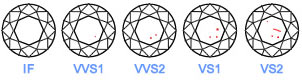
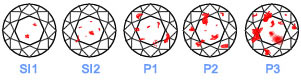
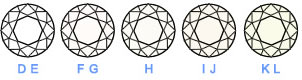
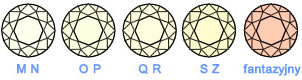
Color, clarity, and cut are also factors that one should be familiar
with. While not as immediately apparent as sheer size, these qualities
can significantly change the price of a stone too. For instance, if your
budget for a single-stone ring is $15,000, you could shop from a range
of diamond sizes between 0.50CW and 2.00CW or more – but it’s likely
that the biggest diamond within your budget will have inclusions, be
imprecisely cut, or slightly off-color. At the end of the day, even
less-than-perfect diamonds are a sight to behold, and only the customer
can determine which is best for their needs.
THE VALUE OF THE CENTER STONE
As previously mentioned, each diamond must be graded for all of the
qualities that give it value before buying or selling a diamond jewelry
piece. The main stone on a diamond ring has a vital role in this process
both visually and financially. As the centerpiece of a ring, it is
naturally the biggest, and more importance is placed on its cut, color,
and other qualities that determine price.
When shopping, one needs to understand this delicate balance, and
know the specific grading terms that appear on an official report from
GIA or IGI. Most shoppers are unaware of the nuances present in a
diamond appraisal or grading, a fact that a disreputable jeweler may
take advantage of.
DIAMOND GRADING: A CRUCIAL STEP IN APPRAISING A DIAMOND
An appraisal isn’t complete without an objective grading. If a
jeweler providing an appraisal does not properly know how to grade a
diamond, they will not be able to provide you with an accurate appraisal
that meets the realities of the market. Without proper equipment, it is
nearly impossible to determine quality in clarity, cut or color, especially when a diamond is still mounted.
The Gemological Institute of America (GIA), the International Gemology
Institute and Gemological Science International (GSI) are organizations
that grade diamonds in a reliable manner, and any diamond you buy or
sell should be accompanied by a report from any one of these
institutions.
BEING SMART ABOUT SELLING YOUR DIAMOND
When it comes time to sell your diamond, it is especially important
to have a grading report. This is to protect both you and the buyer to
prevent any foul play, and to present you as a knowledgeable seller,
perhaps resulting in a better offer. If you choose Worthy to sell your
diamond, not only is the grading covered, but also the auction
connecting your diamond with buyers worldwide. Buyers that participate
in Worthy auctions are professionals who understand the minutiae that
make every diamond unique, which is exactly why we provide complimentary
GIA or GSI gradings. Connect with Worthy today to turn the jewelry you
no longer want into funds for your next vacation, home improvement
project or wherever life takes you.


 1. Most diamonds form more than 100 kilometers below the Earth’s surface
 2. Your diamonds are probably billions of years old
 3. Some diamonds may have come from outer space
 4. Almost 80% of all diamonds are sold in New York City
 5. A diamond can be fractured in one blow
 6. More than a million carats of diamonds are mined each year
 7. There’s a place where you can dig for your own diamonds
 8. The graphite in your pencil shares a unique property with the diamond in your ring
 9. Natural diamonds really are one in a million
 10. There are two formally recognized diamond anniversaries